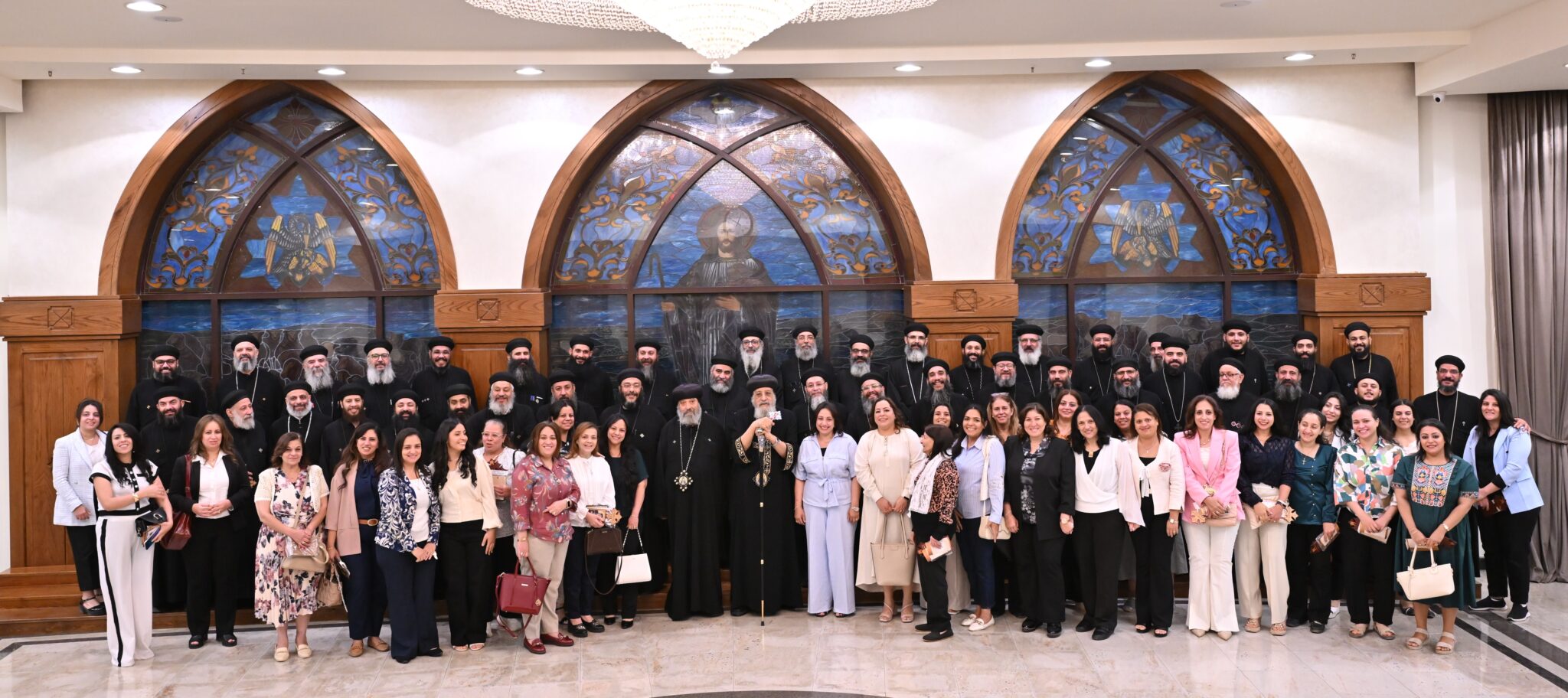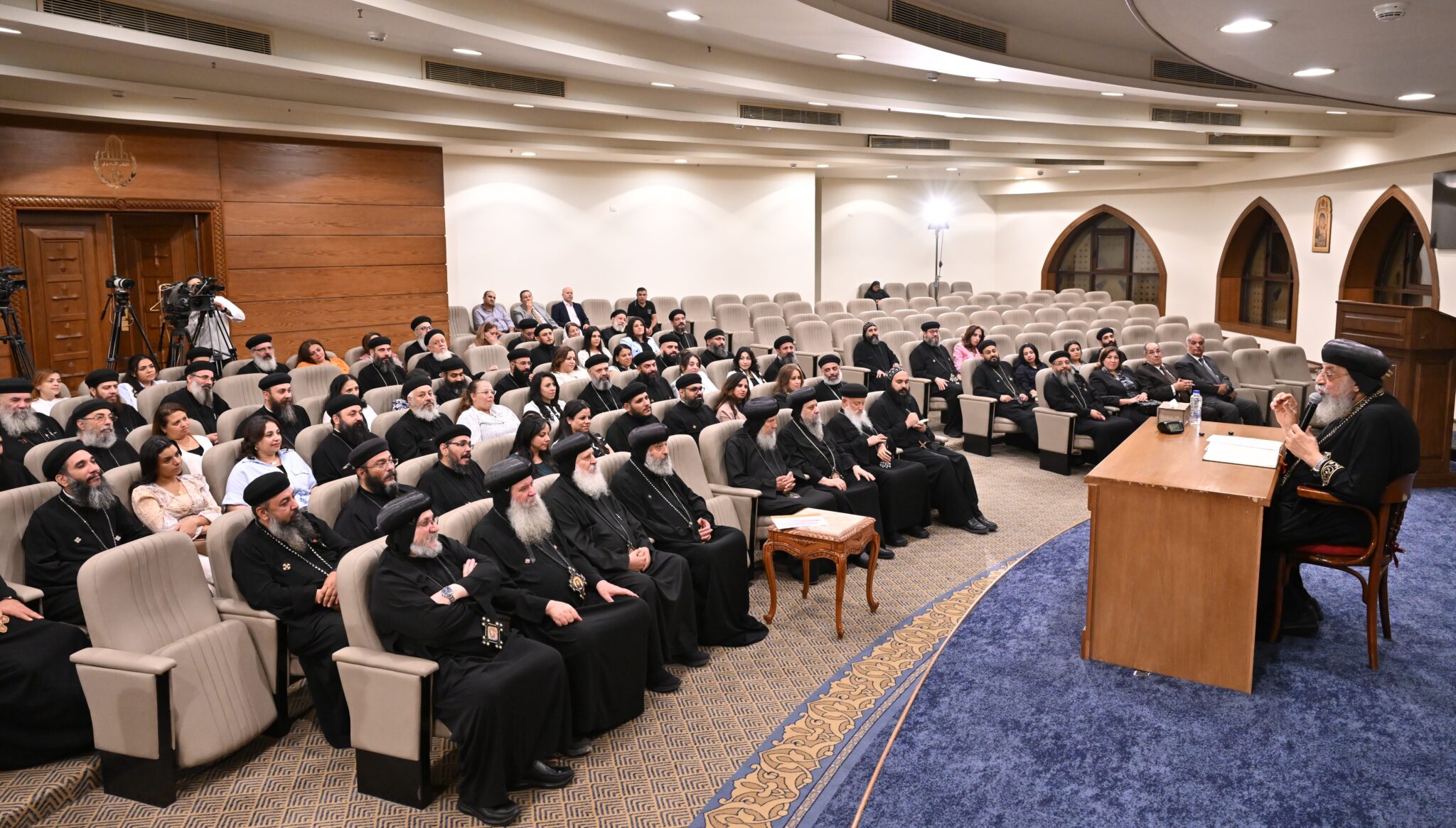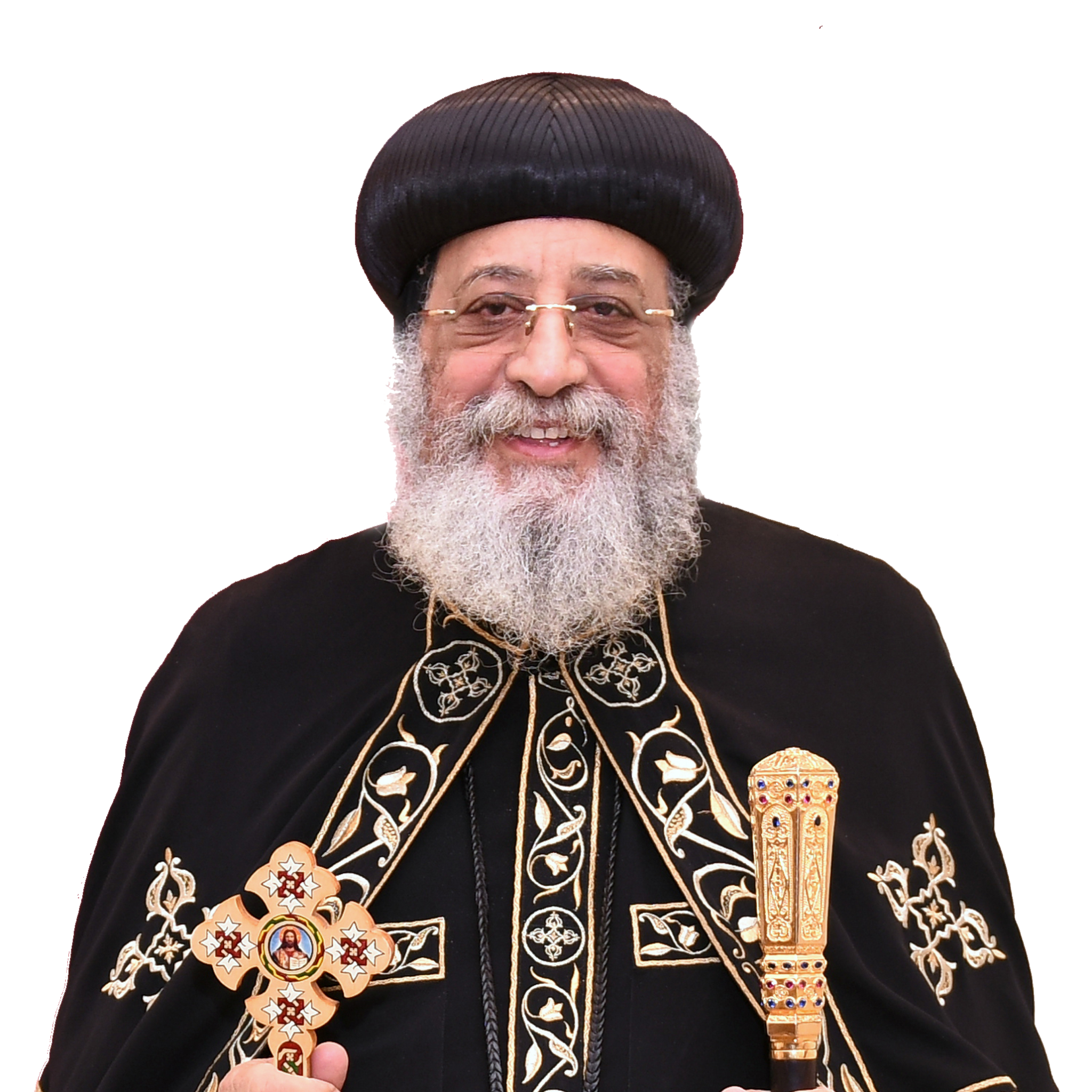

ألقى قداسة البابا تواضروس الثاني عظته باجتماع الأربعاء الأسبوعي مساء اليوم من كنيسة رئيس الملائكة ميخائيل ببيت الكرمة بكينج مريوط.
من كل الأمم من كل القبائل.. شباب كنائسنا بالخارج يسبحون في اجتماع الأربعاء
سبح مجموعة من الشباب من كنائسنا بمختلف دول العالم، بترنيمة “من كل الأمم من كل القبائل ..” وذلك قبل بدء عظة
قداسة البابا تواضروس الثاني باجتماع الأربعاء الأسبوعي الذي عقده مساء اليوم بكنيسة رئيس الملائكة ميخائيل ببيت الكرمة بكينج مريوط.
واصطف الشباب استقبالًا لقداسة البابا لدى دخوله الكنيسة مرتلين بالألحان.
حضر اجتماع الأربعاء من أحبار الكنيسة، أصحاب النيافة الأنبا كيرلس آفا مينا أسقف ورئيس دير الشهيد مارمينا بمريوط والأنبا بافلي الأسقف العام لكنائس قطاع المنتزه والمشرف على خدمة الشباب بالإسكندرية والأنبا إيلاريون الأسقف العام لكنائس قطاع غرب الإسكندرية والأنبا هرمينا الأسقف العام لكنائس قطاع شرق الإسكندرية والأنبا ساويرس الأسقف العام لديري الأنبا توماس بسوهاج والأنبا موسى بالعلمين، والأنبا متاؤس أسقف ورئيس دير السيدة العذراء بجبل إخميم والأنبا إيلاريون أسقف البحر الأحمر.
قداسة البابا يرحب بشباب كنائسنا بمصر والعالم
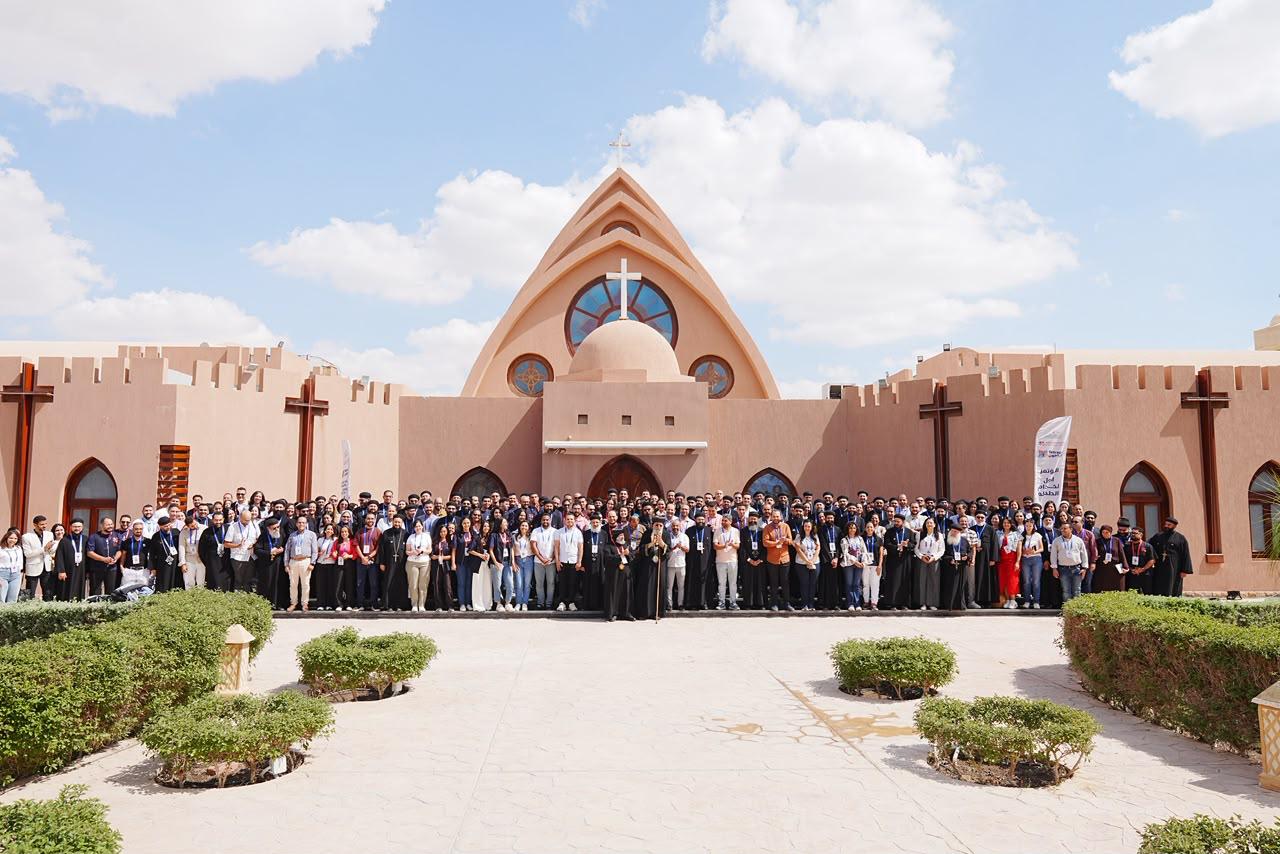
رحب قداسة البابا تواضروس الثاني بمجموعة شباب كنائسنا بالمهجر الذين حضروا اجتماع قداسته الأسبوعي والذي عقده مساء اليوم بكنيسة رئيس الملائكة ميخائيل ببيت الكرمة بكينج مريوط.
وقال قداسة البابا:
في البداية أرحب بمجموعات شباب من كنائسنا القبطية في الولايات المتحدة الامريكية وكندا واستراليا والخليج والسودان ومن مصر و الآباء الأساقفة والكهنة بيرحبوا بيكم، هؤلاء الشباب حضروا العام الماضي مؤتمر الشباب وقضوا ثمانية أيام وهذا الأسبوع عمل روح جيدة بينهم.
وهذا العام طلبوا أن يأتوا يقضون أسبوعًا للخدمة. وهم أتوا يوم الجمعة الماضية وسيبقون حتى السبت القادم. وخدموا في القري وبيوت المسنين وبرامج للأطفال.
وقال قداسته موجهًا كلامه للشباب: بسم الآباء أرحب بكم وأقدر تعبكم وخدمتكم وأنتم نموذج رائع للشباب القبطي وصرتم سفراء فرح.
ربنا يحفظكم ويكمل زيارتكم بخير.
“الوزنات”…. العظة الأسبوعية لقداسة البابا تواضروس الثاني
بسم الآب و الابن والروح القدس الاله الواحد أمين.تحل علينا نعمته وبركته من الأن و إلي الأبد أمين .نقرأ من انجيل متى «وَكَأَنَّمَا إِنْسَانٌ مُسَافِرٌ دَعَا عَبِيدَهُ وَسَلَّمَهُمْ أَمْوَالَهُ، فَأَعْطَى وَاحِدًا خَمْسَ وَزَنَاتٍ، وَآخَرَ وَزْنَتَيْنِ، وَآخَرَ وَزْنَةً. كُلَّ وَاحِدٍ عَلَى قَدْرِ طَاقَتِهِ. وَسَافَرَ لِلْوَقْتِ. فَمَضَى الَّذِي أَخَذَ الْخَمْسَ وَزَنَاتٍ وَتَاجَرَ بِهَا، فَرَبحَ خَمْسَ وَزَنَاتٍ أُخَرَ. وَهكَذَا الَّذِي أَخَذَ الْوَزْنَتَيْنِ، رَبِحَ أَيْضًا وَزْنَتَيْنِ أُخْرَيَيْنِ. وَأَمَّا الَّذِي أَخَذَ الْوَزْنَةَ فَمَضَى وَحَفَرَ فِي الأَرْضِ وَأَخْفَى فِضَّةَ سَيِّدِهِ. وَبَعْدَ زَمَانٍ طَوِيل أَتَى سَيِّدُ أُولئِكَ الْعَبِيدِ وَحَاسَبَهُمْ. فَجَاءَ الَّذِي أَخَذَ الْخَمْسَ وَزَنَاتٍ وَقَدَّمَ خَمْسَ وَزَنَاتٍ أُخَرَ قَائِلاً: يَا سَيِّدُ، خَمْسَ وَزَنَاتٍ سَلَّمْتَنِي. هُوَذَا خَمْسُ وَزَنَاتٍ أُخَرُ رَبِحْتُهَا فَوْقَهَا. فَقَالَ لَهُ سَيِّدُهُ: نِعِمَّا أَيُّهَا الْعَبْدُ الصَّالِحُ وَالأَمِينُ كُنْتَ أَمِينًا فِي الْقَلِيلِ فَأُقِيمُكَ عَلَى الْكَثِيرِ. اُدْخُلْ إِلَى فَرَحِ سَيِّدِكَ. ثُمَّ جَاءَ الَّذِي أَخَذَ الْوَزْنَتَيْنِ وَقَالَ: يَا سَيِّدُ، وَزْنَتَيْنِ سَلَّمْتَنِي. هُوَذَا وَزْنَتَانِ أُخْرَيَانِ رَبِحْتُهُمَا فَوْقَهُمَا. قَالَ لَهُ سَيِّدُهُ: نِعِمَّا أَيُّهَا الْعَبْدُ الصَّالِحُ الأَمِينُ كُنْتَ أَمِينًا فِي الْقَلِيلِ فَأُقِيمُكَ عَلَى الْكَثِيرِ. اُدْخُلْ إِلَى فَرَحِ سَيِّدِكَ. ثُمَّ جَاءَ أَيْضًا الَّذِي أَخَذَ الْوَزْنَةَ الْوَاحِدَةَ وَقَالَ: يَا سَيِّدُ، عَرَفْتُ أَنَّكَ إِنْسَانٌ قَاسٍ، تَحْصُدُ حَيْثُ لَمْ تَزْرَعْ، وَتَجْمَعُ مِنْ حَيْثُ لَمْ تَبْذُرْ. فَخِفْتُ وَمَضَيْتُ وَأَخْفَيْتُ وَزْنَتَكَ فِي الأَرْضِ. هُوَذَا الَّذِي لَكَ. فَأَجَابَ سَيِّدُهُ وَقَالَ لَهُ: أَيُّهَا الْعَبْدُ الشِّرِّيرُ وَالْكَسْلاَنُ، عَرَفْتَ أَنِّي أَحْصُدُ حَيْثُ لَمْ أَزْرَعْ، وَأَجْمَعُ مِنْ حَيْثُ لَمْ أَبْذُرْ، فَكَانَ يَنْبَغِي أَنْ تَضَعَ فِضَّتِي عِنْدَ الصَّيَارِفَةِ، فَعِنْدَ مَجِيئِي كُنْتُ آخُذُ الَّذِي لِي مَعَ رِبًا. فَخُذُوا مِنْهُ الْوَزْنَةَ وَأَعْطُوهَا لِلَّذِي لَهُ الْعَشْرُ وَزَنَاتٍ. لأَنَّ كُلَّ مَنْ لَهُ يُعْطَى فَيَزْدَادُ، وَمَنْ لَيْسَ لَهُ فَالَّذِي عِنْدَهُ يُؤْخَذُ مِنْهُ. وَالْعَبْدُ الْبَطَّالُ اطْرَحُوهُ إِلَى الظُّلْمَةِ الْخَارِجِيَّةِ، هُنَاكَ يَكُونُ الْبُكَاءُ وَصَرِيرُ الأَسْنَانِ. ( إنجيل متى ٢٥: ١٤-٣٠)
موضوع تأملنا الليلة “الوزنات” و الوزنات نعمة يعطيها الله للإنسان ولا يوجد إنسان بلا وزنات وكل واحد أُعطي حسب طاقته وهنا لا يوجد تساوي لكن المهم كيف تعمل بالوزنة و الوزنات تمثل العمر.
صاحب الخمس وزنات و الوزنتين تاجروا بهم وربحوا مثلهم أما صاحب الوزنة الواحدة دفنها في التراب
الوزنة المشتركة هي الوقت وهو موزع بالتساوي على الكل و أيضًا الله أعطانا خمس حواس كوزنة بها نتلامس مع حب الله والناس ووزنتين آخرتين أيضًا محبة الله ومحبة الناس. وصاحب الوزنة الواحدة أن هذا الانسان كان انانيا ولا ينظر غيره وعندما يعطينا الله الوزنات هي عطايا وامكانيات مثل “الأسرة ،الطاقة الفكرية،الخدمة ولكي نتعرف علي الوزنات يجب أن:
١ – اعرف نفسك
أنت غالي عند المسيح مثلما افتقد القديس بولس الرسول هذا الافتقاد جعله يخدم خدمة عظيمة وهو سأل الله “ماذا تريد أن افعل ؟” اعرف نفسك وصفاتك وامكانياتك وعلم نفسك بالملاحظة
٢-اقبل نفسك
يوجد من هو ثائر على نفسه دائمًا ولا تعجبه ذاته لكن انظر لنفسك الله اعطاك امكانيات شطارتك ان تكتشفها و الله خلقنا بنعمل لا للكسل وكل ظروفي تعمل جيدا للخير
٣-اعرف نوع شخصيتك
يوجد شخصية اجتماعية وسط المجتمع تعمل علاقات وذات مركز للكثيرين وشخصية قيادية واخري هادئة تميل للتأمل وتوجد شخصية باحثة عن الكمال تتظم عمل واعجبتني عبارة قالها”ميخائيل مليكة” الحياة استمرار ولا وقوف فيها ولا جمود أنها دائرة كل نقطة فيها تصلح أن تكون بداية ونهاية في آن واحد. وزناتك التي اعطاها الله لك متنوعة .
ممكن تكون :
١ – وزنة عقلية:
ترحب بالقراءة و البحث و التوضيح و الترجمة
٢- وزنة ادبية
الادب يجمع خلاصة النفس والمواهب الأدبية تجعلك تتعلم من سلوكيات الناس و الشطارة هي تنمية مواهبك على الدوام
٣- المواهب الحركية
افتقاد -بحث عن الضال-الرياضة-الكرازة
٤- وزنات اجتماعية
مثل العمل الاجتماعي و التنموي مثل الصدقات
٥- وزنات فنية
مثل الرسم و الموسيقي و التشكيل وفنون الأداء وبيكاسوا قال”كل انسان يولد ولديه مواهب و المشكلة كيف نحفظها”
٦- المواهب التعبدية
مثل الألحان ،التسبيح ،اجتماعات الصلاة ،التكريس
٧- المواهب الإلكترونية
– الوزنة :
١-كل شخص الله اعطاه وزنة مختبئه بداخله والله يعطينا وزنات حسب طاقتنا ليس كل شخص مثل الآخر الله يعطينا الوزنات لنشكره ونخدم الآخرين ولكي نشعر في داخلنا بالإنجاز
٢- لا يوجد أحد بدون مواهب
ومهمتنا كأباء وخدام أن نكتشف مواهب الآخرين و العين الروحية تكتشف مواهب الآخرين
٣- الإنسان لا يفهم الذات
مثل موسى النبي واحتقاره لذاته وهذا يحتاج لمرشد يساعده
٤- الوزنة تزداد بحسن الإستخدام وتتلاشى بعدم الاستخدام
٥- الوزنة استخدمها حتي الموت “كن امينا إلي الموت”
الوزنات عمل مهم نعمة نشكر بها ربنا ونخدم بها الآخرين وتجعلنا نخرج من ذاتنا لنكون ناجحين. لالهنا كل مجد وكرامة من الآن وإلى الأبد أمين
In the name of the Father, and of the Son, and of the Holy Spirit. One God. Amen. May His grace and His mercy rest upon us, from now and forevermore. Amen.
By the grace of Christ I will read a portion from the 25th Chapter of the Gospel of our teacher St. Matthew the Evangelist, a chapter in which He talks about different parables, among them the parable of the talents.
14 “For the kingdom of heaven is like a man traveling to a far country, who called his own servants and delivered his goods to them. 15 And to one he gave five talents, to another two, and to another one, to each according to his own ability; and immediately he went on a journey. 16 Then he who had received the five talents went and traded with them, and made another five talents. 17 And likewise he who had received two gained two more also. 18 But he who had received one went and dug in the ground, and hid his lord’s money. 19 After a long time the lord of those servants came and settled accounts with them.
20 “So he who had received five talents came and brought five other talents, saying, ‘Lord, you delivered to me five talents; look, I have gained five more talents besides them.’ 21 His lord said to him, ‘Well done, good and faithful servant; you were faithful over a few things, I will make you ruler over many things. Enter into the joy of your lord.’ 22 He also who had received two talents came and said, ‘Lord, you delivered to me two talents; look, I have gained two more talents besides them.’ 23 His lord said to him, ‘Well done, good and faithful servant; you have been faithful over a few things, I will make you ruler over many things. Enter into the joy of your lord.’
24 “Then he who had received the one talent came and said, ‘Lord, I knew you to be a hard man, reaping where you have not sown, and gathering where you have not scattered seed. 25 And I was afraid, and went and hid your talent in the ground. Look, there you have what is yours.’
26 “But his lord answered and said to him, ‘You wicked and lazy servant, you knew that I reap where I have not sown, and gather where I have not scattered seed. 27 So you ought to have deposited my money with the bankers, and at my coming I would have received back my own with interest. 28 So take the talent from him, and give it to him who has ten talents.
29 ‘For to everyone who has, more will be given, and he will have abundance; but from him who does not have, even what he has will be taken away. 30 And cast the unprofitable servant into the outer darkness. There will be weeping and gnashing of teeth.’”
(Matthew 25:14-30)
The grace of God the Father be with us all. Amen.
We have many young people here with us today visiting from all around the world. These young people had participated in last year’s International Coptic Youth Conference and wanted to return to Egypt this year to spend a week doing service work, sharing their talents, and this is why I prepared tonight’s contemplation on the subject of talents, and also in light of the parable I just read to you.
Talents are a grace God gives people and there is no one that is not given talents. And according to the parable He gives us, this man called in three servants – to the first he gave five talents, to the second he gave two talents, and to the third he gave one talent. And there is no room here for us to ask why or say, “It’s not fair,” because the Bible tells us that he gave to each one “according to his own ability.” For example, a person may be able to lift ten kilograms, another person can lift up twenty, another person can carry thirty, each one according to his own ability, and so this is not a matter of equality but what is important is what you do with your ability.
God did not create a single human without talents; each one of us has talents, and the stage of youth is the most beautiful stage in one’s life for a person to discover what talents the Lord has given him.
When he gave him five talents and told him he would leave him for a period of time, this period of time represents life, the period of life each one of us is given. What will you do with the talents you have been given?
And so the one who was given five talents took them and traded or invested them – according to today’s language – and gained five more talents, and so he accomplished a 100% return.
This result was astounding and so his lord told him, “You were faithful over a few things, I will make you ruler over many things. Enter into the joy of your lord.”
You were faithful over a few things – the five talents
I will make you ruler over many things – I will give you more abilities
Enter into the joy of your lord – you will have a portion with Me in heaven
And the one who had been given two talents, he produced the same return and was given the same invitation. But the one who received one talent, he took it and buried it in the dust and said to himself, “Whenever its owner returns, I will give it back to him.” Okay, but in what condition will you return it to him? When he returned it to him it was full of dust and he said, “Here is your talent back.”
“But why did you ever do that with it?” his lord must have asked, and the servant said, “I kept your talent safe by burying it in the ground. Didn’t you want it back? Here it is. I did really good, didn’t I?” But his lord said, “No, you wicked and lazy servant.”
Use time wisely
And here is one of the key lessons in this parable, which is about the importance of correctly utilizing time. The two who had received the five talents and the two talents, they used the time wisely, but the person who received one talent did not use the time wisely. And what is so special about time? Because time is one of those talents that the Lord gives us all equally – like the air, the water, and the sun. Every day each one of us receives 24 hours, the question is, what do we do with these hours?
Our friend buried them in the dust and sat around lazily. And when you read the verses in the Bible, the descriptions used are very tough – “You wicked and lazy servant,” and then at the very end of the parable it says, “Cast the unprofitable servant into the outer darkness. There will be weeping and gnashing of teeth.” Weeping and gnashing of teeth represent regret, where one says, “I wish I had used the time wisely, I wish I had used these talents, I wish I would have used them to produce returns.” But when one blames himself, this does not accomplish anything at all because he has already wasted the time, and when time is wasted, it can never be regained.
Another example of talents the Lord gives us all equally are the five senses, and it is through the five senses that we are able to intimately interact with the love of God and the love of people. He also gives another two talents, which are represented by the two beams of the cross, which are, once again, the love of God and the love of people. As for the one talent, it symbolizes the greed of a person and his being self-centered, his whole world is centered on himself, and this is the source of all the problems in our lives.
Why does the Lord give us talents and how do we discover them?
Talents are graces and abilities God gives us. Each one of us has been given different blessings and abilities. There is one who has a family and this family is a talent God gave him in the sense that if he invests time and resources in his family, he will raise a family that will become Church servants and be a blessing to others. Another person has good health and physical energy, another one has intellectual abilities, another one has an ability to study and to learn, another one has the talent of serving others – service in all its forms, and I will explain a little bit later, but these are all different forms of talents.
3 things you need to know in order to begin using your talents
Know yourself
And so how do we begin to use our talents? The first thing is that you need to know yourself. You need to know yourself, to know that you are a soul who has been redeemed by the blood of Christ on the cross. You are precious, precious in the eyes of Christ. Also, in order to get to know yourself, stand before the Lord and ask, “Lord, what talent or talents have You given me?”
I will remind you of someone you like very much. He was very far from the Lord but when Christ appeared to him on the road to Damascus and he began to have an intimate interaction with Christ, he made a very nice statement, he said, “Lord, what do You want me to do?” (Acts 9:6) – “Okay, so You have given me talents, what do You want me to do with them?”
And he took his period of solitude and it was after this time of solitude, which had prepared him, St. Paul leapt forward into evangelism, and then we marvel when look at all St. Paul the Apostle accomplished, in history and in spiritual evangelism and how he traveled to many countries – it is said that the Apostle Paul walked 20,000 kilometers on his feet!
Long time ago there were no airplanes, no trains, no cars, no paved roads, nor even safe roads – none of these things were available. He only had three choices before him: either to ride a ship and travel by sea, to walk on his feet, or to ride on the back of some animal.
But when he stood before the Lord and asked this question: “Lord, what do You want me to do?” the Lord began to reveal this to him and told him, “You will be for Me an evangelist and a prophet in many nations. You will present My name to all people” (cf. Acts 9:15-16). And there came a day when St. Paul made another beautiful statement saying, “I am an ambassador in chains” (Eph 6:20) – and this he said while he was in prison. An ambassador in chains. An ambassador is a nice position to have, but an ambassador in chains? However, he did not see these chains as obstacles but he saw them as being as gold bracelets, a kind of honor.
And so the first thing you must know are your attributes and your capabilities, and you can also know yourself by training yourself through noticing, to notice what you are able to do or able to learn.
Accept yourself.
May the Lord protect you all, but there are people who do not accept themselves. Such a person sort of rebels against himself and is dissatisfied with himself, and he is continually looking outward, “That person is better than me, and she is better than me, and this one has that thing, and that one has more than I do,” but why don’t you look to yourself? God has given you capabilities and it is up to you to discover them. God has a plan for each of our lives and through the talents He gives us He is able to accomplish this plan.
After World War II, a man was born into a family who sold the remnants from the war – things like empty bullet shells, rusted things, and parts of destroyed ships – that was the kind of area he was born in. When he was a young man he began thinking to himself, “I can make artful crafts out of these things,” and so he began to take the parts and fragments of war which had been buried in the ground and spread throughout, and he began to shape them. They were different kinds of metals and he produced marvelous pieces of art out of them, and he began to hold art exhibitions, and so he began his path in this way. He did not know that God had placed this talent in his hands and in his fingers, but he discovered it.
God has a plan for each one of our lives and the plan calls for activity. The Lord did not create us for us to just sit around lazily, but the Lord created us so that we would be active and hardworking. And a nice verse that you all know says, “All things work together for good to those who love God” (Rom 8:28), meaning that all the circumstances surrounding me can be wisely used and turn out for the good, so long as I am a person who is filled with the love of the Lord.
Know your personality type
Out of His love for us, the Lord creates us with a variety of types of personalities. There is a social type of personality, there is a leadership type of personality, there is a quiet personality.
One time I attended a study group and there were 40 of us there, and they wanted to select a leader from among us, so how were they to choose? So they did a very nice experiment with us. They got a rope and tied it into a loop, and they stood us around in a very big circle, all of us holding onto the rope. Can you imagine this scene in your mind?
And then the instructor asked us to make a star shape out of the rope but we all just stood there in a circle not knowing what to do, and he was observing us. And then what began to happen was that one of the 40 assumed the role of the leader and began to tell this one to move to the inside, and that one to move more to the outside, until he had us form a star, and they chose this person to be the leader. He was able to direct the other 39 people.
There is a personality type that is more quiet. This personality leans towards contemplation and toward hearing the Word and digesting it.
There is another type of personality that is social and does well in community. This personality is very capable of being with people, talking to people, establishing relationships with them, and this personality becomes an anchor for others.
There is a type of personality that likes organization and seeks perfection. This personality is good at managing events, for example, managing a day of spiritual retreat or managing a program of activity or a service program.
And I have here before me a statement made by Mikhail Naimy, a poet and writer who during his life had lived abroad; he was Lebanese and had immigrated to Latin America. He makes a very nice statement, he says, “Life is continuity and there is no standing still in it nor inflexibility. It is the circle upon which every point is fit to be a beginning and an ending, simultaneously.”
And so life is like a circle, and each point on it is both the end of one thing and the beginning of another thing, at the same time. In life, there is constant activity.
The talents the Lord gives you may be various, and I will mention a few of them here. It may be an intellectual talent, for example, you like to read or you like to research or you like to write, or you have the gift of clarifying things for others, or you like to learn or to teach or to interpret. And so we can refer to this talent as a literary talent, and literature gathers and distills the essence of the soul, the human soul.
And as you know, they refer to each one of us as a “micro-cosmos” – a miniature world, and they refer to the world we live in as a “macro-cosmos” – the larger world, and so it is as if we are small worlds living in a bigger world. Each one of us is a world, an entire world.
And so if you have these literary talents then you can become an instructor or a writer or a poet. Around two days ago, one of the young girls whom you served stood up before all of you and with great confidence began to share a very beautiful and very long piece of poetry she had composed. She was just a third or fourth grader but she stood in front of a group of adults. This is a talent, a talent she has from her youth, and the smart thing to do is to nurture these talents continually.
Another type of talent is the ability of physical activity, when one is able to be physically active all the time. Such a person can use this ability to do home visits, seek out others and befriend them, seek out those who are lost, evangelize – because evangelizing requires a person who has a lot of energy and is always active. This talent can also be used for physical exercising and sports, and there are many forms of physical exercise.
There are also social skills and social talents, such as social work and volunteering, or mentoring or building friendships.
There are also artistic talents, such as drawing, music, or any type of creative artwork in general, or the performance arts. I remember when we were once doing a program for talented children and we had invited a boy and girl from each patriarchate from across all of Egypt to come and participate, and a nine year-old girl named Miriam from Upper Egypt came and her acting abilities that were so superior.
So for example, this young girl, Miriam, stood before all of us and acted out the story of the Canaanite woman and her sick daughter and the Person of Christ. All by herself, she played all three parts! She would lean forward and pretend to be the mother, and the next moment she would stand up straight, mess her hair up and play the part of the demon-possessed daughter, and the next moment she would play the part of Christ speaking to the girl, and she would have you 100% convinced. This girl is now in university or is a university graduate, but this is a talent, and talents need to be nurtured.
Picasso, the world famous artist said that every person is born with talents, but the problem is how to preserve these talents.
There are also talents in the area of worship, these include singing hymns, participating in prayer meetings, praising, contemplation, and consecration. When a person has the talent of worship they feel that spending an hour with the Lord is good, and two hours is even better. And they go from spending an hour with the Lord once a week, to once every day, and then twice a day. And so it continues to increase until the person reaches the point where they say, “Lord, I want my whole life to be consecrated to You. I want every day and every hour to be for You, Yours.”
Some people have a talent when it comes to electronics and they do good work with many contemporary technologies and programs and applications that can be of benefit to everyone.
The 4 principles of investing a talent
The last thing I want to talk to you about are the rules of investing the talent. The talents the Lord gives us He does not just give them to us haphazardly, but He gives them to us within the context of principles.
Every individual has been given talents
The first principle is that God has given every individual talents. Do not dare to think to yourself nor even stand before the mirror and say, “I don’t have talents. I’m not really good at doing anything.” There is a talent or talents hiding within you.
And I have before me a very beautiful statement made by Napoleon Bonaparte, he said, “I used to respond with three about three. To the one who said, ‘I cannot,’ I told him to attempt it, to the one who said, ‘I do not know,’ I told him to learn, and to the one who said, ‘Impossible,’ I told him to try.” And in this way a person invests their talents.
God gives each one of us talents according to our abilities, and not in the same way He gives my brother or my sister. God may have given my brother or sister more talents than He has given me, very good.
God gives us talents for three reasons
Number one – to thank Him. “Thank You Lord for this talent. You have given me the ability to be a servant and to serve, You have given me the ability to be consecrated,” and so on, for any talent He has given you, thank Him.
Number two – to serve others with this talent. God does not give me the talent for me, but He gives it to me so that I may serve others with it.
Number three – the Lord gives us talents so that we may feel a sense of accomplishment. For a person to sense the feeling of achievement of, “Yes, I can do this, I can be innovative, I can create something,” this sense of achievement is important in a person’s life.
I don’t know if you know this story that happened with the 19th Coptic Pope. His monastic cell faced the Mediterranean Sea here in Alexandria, and one day, in his old age, he was looking out through the window in his cell and saw some children playing. But one of them stood out in the way he played because he assumed the role of the leader, and from afar the Pope looked and said, “This boy is gifted. God has given him talents.”
And so he asked this little boy, “What is your name dear?” The boy said, “My name is Athanasius.” And he raised this boy alongside him and the boy grew and became a deacon, and who would have ever believed that this young boy who played would become the 20th Patriarch? Who would have ever guessed that? If someone were to use their imagination to imagine it, it would be impossible, but the eye, the spiritual eye that has no ego, it discovers the gifts within others, and as Church servants and Church fathers, it is also one of our duties to help others discover their gifts.
There are many other stories like this, for example St. Augustine, the intercessor of penitents, whose feast day we celebrate today. Augustine had studied law and was a lawyer, and he was an excellent speaker and orator, but just between you and I, he was quite impressed with himself and with his personality. Okay, so then what Augustine?
He began to become part of the upper class and felt that he was better than everyone else, and so he began to stray. And he walked in the way of sin for twenty years, with his mother behind him praying for him to return, but Augustine would make fun of his mother’s tears when he saw her crying.
But when one day a book called The Life of St. Anthony – who is the father of Monks – found its way into his hands, it caught his attention. This was during the 3rd and 4th Centuries and so it was the time of the beginnings of monasticism. And Augustine wondered, “Is it really possible for someone to live like this? For someone to leave their family and a life of wealth and go live in the desert?” And so he was greatly influenced by the life of St. Anthony.
And when he had outgrown his hometown Thagaste in Algeria, he thought to himself, “I will go to Milan, it is an international world capital.” And so he went to Milan and there he met St. Ambrosius, the Bishop of Milan, and he was impressed by his sermons.
His mother, this very kind and praying woman, followed him to Milan and went to Bishop Ambrose and said, “My son, Augustine, is going to be lost! If he was beginning to deviate in the small town, whatever will happen to him here in this big city? He is going to be completely lost.”
And Bishop Ambrose looked at Monica, Augustine’s mother, and said, “Do not be afraid. These tears of yours, every single one of them is known to the Lord and this son of yours will not perish.” And so it was that the mother’s tears, the life of Anthony, the sermons of Ambrose – the three together encircled Augustine and made a great saint out of him, and now we refer to him as “the son of tears” and ”the intercessor of the penitents.”
Furthermore, Augustine was the first in [Christian] history to do two things: He wrote his confessions – The Confessions of Augustine, one of the most powerful spiritual books, and the second thing he did was to establish what is known as “monasteries of patriarchates” or the establishing of a monastic community within a patriarchate. He had been an assistant to the Metropolitan but when he began to repent he said, “I want to live in a monastic environment,” and so he began to build a home for monks to live and serve with him in the Patriarchate, in order that monks would always be before him and in this way he would never lose sight of the monastic life.
Did Augustine ever know that he would write his confessions or that his confessions would be of spiritual benefit to us to this day? No, and who would have ever guess it? But it was a talent that he used wisely.
The irony of not knowing your own talents
An ironic principle regarding one’s talents is that oftentimes we don’t know ourselves – a person doesn’t know himself or his own talents. I’ll give you a familiar example, the Prophet Moses. When the Lord told the Prophet Moses to go before Pharaoh, Moses said, “Me, go? ‘I have never been eloquent … I am slow of speech and tongue … and I speak with faltering lips’ (Exo 4:10, 6:30), how can I go?” And so he began to put himself down, which is what we refer to today as “low self-esteem.”
Or you may remember Gideon, one of the judges, when he prepared large numbers of people to go face the Midianite enemies. And it says, “The Angel of the Lord appeared to him and called him a “mighty man of valor!’” (cf. Judg 6:12), but what was Gideon’s response? Gideon’s response was, “My Lord, how can I save Israel? Indeed my clan is the weakest in Manasseh, and I am the least in my father’s house” (Judg 6:15). He was basically saying, “My tribe and my family are the weakest of all,” but the Lord told him, “No, I will use you,” and today we refer to Gideon as a symbol of strength.
And we hear about Jeremiah the Prophet and Peter the fisherman and others, and how so often a person does not know how to value themselves; he simply does not know how, and so here we see the need for our Church servants and spiritual guides help us along in this area.
Talents increase with right use and waste away with lack of use
The third principle with regard to talents is that a talent increases with right use and it wastes away with lack of use.
Simply put: service begets service, and more service, but suppose I become lazy? Laziness begets more laziness and sleep begets more sleep. There is an Egyptian proverb that says, “The fruit of sleep is more sleep,” meaning that if you sow sleep, you will reap more sleep, and if you sow laziness, you will reap laziness.
Do you know how when a person yawns in front of others what happens? The others too begin to yawn like him, involuntarily, they too will want to sleep, is it not so? Does this also happen with people outside of Egypt or does this phenomena only occur here in Egypt? Oh yes, it happens everywhere.
And likewise, activity begets activity, so suppose I want to learn how to chant hymns, then I should befriend people who like hymns, or suppose I want to learn the Bible, I should befriend people who like the Bible, or suppose I want to learn how to conduct Church house-visits, then I should make friends with people who are good at making house-visits, or suppose I want to learn a language, then I should make friends with people who know that language, and so on.
Talent increases with right usage, and talent wastes away from lack of use.
A talent must be used until death
The last point is that the talent you have, use it unto death. “Be faithful until death” (Rev 2:10). Be faithful with every talent God has given you. And here I would like to let the young people who serve know that we do not only serve during our time of youth, no, but we remain servants throughout our lives.
Even after you grow older and travel to different countries and make your own families, we continue to be servants and we teach servanthood to our children, and so on.
Talents are a very important subject. They are a grace for which we thank the Lord. We serve others with them, they give us a sense of who we are, they provide us with a sense of personal achievement within ourselves, and they get us outside of ourselves and out of our own egos so that a person is not self-centered like the man who took the one talent and buried it in the dust, but to get outside yourself. And a person who gets outside himself is a person who will always succeed.
To our God be all glory and honor from now and forevermore. Amen.