
• Home
  • Coptic Church
    • Holy Bible
      • Old Testament
      • New Testament
      • Stories for Kids
      • Historical Jesus
    • Coptic History
    • Holy Family
    • Coptic Popes
    • Papal Residence
    • Kiraza Magazine
    • LOGOS Coptic Youth Forum
    • LOGOS Leadership Program
    • LOGOS Junior Forum
    • Coptic Tours 360°
    • Coptic Language
    • Church Evangelism
    • Church Books
    • Saints Stories
    • Coptic Museum
    • Coptic Gallery
  • Holy Synod
    • Pope Tawadros II
    • Holy Synod Members
    • Committees Structure
      • Standing Committee
      • Secretarial Committee
      • Pastoral Care & Service Committee
      • Rites Committee
      • Faith & Teaching Committee
      • Family Committee
      • Media & Information Committee
      • Public Relations Committee
      • Ecumenical Relations Committee
      • Monasticism & Monasteries Committee
      • Coptic Diaspora’s Affairs Committee
      • Diocesan Affairs Committee
    • Holy Synod Regulations
    • Holy Synod Decrees
    • Papal Decrees
    • Holy Synod Seminars
    • Ecumenical Relations
      • The Ecumenical Councils
      • The Ecclesiastical Families
      • Relations with the Oriental Orthodox Churches
      • Relations with the Byzantine Orthodox Churches
      • Relations with the Catholic Church
        • 50 Years of Brotherly Love (1973-2023)
      • Relations with the Evangelical Churches
      • Relations with the Anglican Church
      • Relations with the Assyrian Church
      • Church Councils
      • Ecumenical Work of the Church Patriarchs
    • Deceased Bishops
  • Pope Tawadros II
    • Biography
    • Papal Messages
    • Friendship Day Messages
    • Pope’s Books
    • Kiraza Editorial Articles
    • Internal Visits
    • Visits Abroad
    • Bible Study
    • Wednesday’s Sermons
    • TV Interviews
    • Speeches
    • Pope’s Video
    • FAQ
  • Monasteries & Dioceses
    • Ancient Monasteries/Convents
    • Modern Monasteries/Convents
    • Monasteries/Convents Abroad
    • Egypt Dioceses
    • Dioceses Abroad
    • LOGOS Papal Center
    • Spiritual Centers
      • Patmos
      • Anafora
  • Entities
    • General Bishoprics
      • Bishopric of Public, Ecumenical & Social Services
      • Youth Bishopric
    • Educational Entities
      • Central Papal Library
      • Coptic Studies Institute
      • Coptic Clerical & Theological College
      • Coptic Institute for Church Administration & Development
      • Pastoral Care and Education Institute
      • Coptic Orthodox Cultural Center
      • St. Mark Foundation for Coptic Heritage
      • Holy Sophia University
      • St. Paul Institute for Ministry Studies
      • St. Pantinous for Professors Assembly
    • Social Entities
      • Coptic Orthodox Endowments Authority
      • Coptic Orthodox General Religious Council
      • Papal General Court
      • Saint Rewis Theater
    • Development Entities
      • Bishopric of Public, Ecumenical & Social Services
      • Social Care Committee
      • Papal Office for Projects
      • HIGH Office
    • Media Entities
      • Kiraza Magazine
      • Coptic Media Center
      • Coptic Website
      • COC
      • Aghapy TV
      • CTV
      • ME Sat
      • CYC
      • Koogi TV
    • Health Entities
      • Ragaa Center
  • News
    • Official Meetings
    • Pastoral Meetings
    • Church Occasions
    • Papal Messages
    • Friendship Day Messages
    • Wednesday’s Sermons
    • TV Interviews
    • Speeches
    • Communications
  • English
  • Home
  • Coptic Church
    • Holy Bible
      • Old Testament
      • New Testament
      • Stories for Kids
      • Historical Jesus
    • Coptic History
    • Holy Family
    • Coptic Popes
    • Papal Residence
    • Kiraza Magazine
    • LOGOS Coptic Youth Forum
    • LOGOS Leadership Program
    • LOGOS Junior Forum
    • Coptic Tours 360°
    • Coptic Language
    • Church Evangelism
    • Church Books
    • Saints Stories
    • Coptic Museum
    • Coptic Gallery
  • Holy Synod
    • Pope Tawadros II
    • Holy Synod Members
    • Committees Structure
      • Standing Committee
      • Secretarial Committee
      • Pastoral Care & Service Committee
      • Rites Committee
      • Faith & Teaching Committee
      • Family Committee
      • Media & Information Committee
      • Public Relations Committee
      • Ecumenical Relations Committee
      • Monasticism & Monasteries Committee
      • Coptic Diaspora’s Affairs Committee
      • Diocesan Affairs Committee
    • Holy Synod Regulations
    • Holy Synod Decrees
    • Papal Decrees
    • Holy Synod Seminars
    • Ecumenical Relations
      • The Ecumenical Councils
      • The Ecclesiastical Families
      • Relations with the Oriental Orthodox Churches
      • Relations with the Byzantine Orthodox Churches
      • Relations with the Catholic Church
        • 50 Years of Brotherly Love (1973-2023)
      • Relations with the Evangelical Churches
      • Relations with the Anglican Church
      • Relations with the Assyrian Church
      • Church Councils
      • Ecumenical Work of the Church Patriarchs
    • Deceased Bishops
  • Pope Tawadros II
    • Biography
    • Papal Messages
    • Friendship Day Messages
    • Pope’s Books
    • Kiraza Editorial Articles
    • Internal Visits
    • Visits Abroad
    • Bible Study
    • Wednesday’s Sermons
    • TV Interviews
    • Speeches
    • Pope’s Video
    • FAQ
  • Monasteries & Dioceses
    • Ancient Monasteries/Convents
    • Modern Monasteries/Convents
    • Monasteries/Convents Abroad
    • Egypt Dioceses
    • Dioceses Abroad
    • LOGOS Papal Center
    • Spiritual Centers
      • Patmos
      • Anafora
  • Entities
    • General Bishoprics
      • Bishopric of Public, Ecumenical & Social Services
      • Youth Bishopric
    • Educational Entities
      • Central Papal Library
      • Coptic Studies Institute
      • Coptic Clerical & Theological College
      • Coptic Institute for Church Administration & Development
      • Pastoral Care and Education Institute
      • Coptic Orthodox Cultural Center
      • St. Mark Foundation for Coptic Heritage
      • Holy Sophia University
      • St. Paul Institute for Ministry Studies
      • St. Pantinous for Professors Assembly
    • Social Entities
      • Coptic Orthodox Endowments Authority
      • Coptic Orthodox General Religious Council
      • Papal General Court
      • Saint Rewis Theater
    • Development Entities
      • Bishopric of Public, Ecumenical & Social Services
      • Social Care Committee
      • Papal Office for Projects
      • HIGH Office
    • Media Entities
      • Kiraza Magazine
      • Coptic Media Center
      • Coptic Website
      • COC
      • Aghapy TV
      • CTV
      • ME Sat
      • CYC
      • Koogi TV
    • Health Entities
      • Ragaa Center
  • News
    • Official Meetings
    • Pastoral Meetings
    • Church Occasions
    • Papal Messages
    • Friendship Day Messages
    • Wednesday’s Sermons
    • TV Interviews
    • Speeches
    • Communications
  • English
Facebook-f Instagram Youtube X-twitter Threads Soundcloud Bullseye
  • Home
  • >
  • Kiraza Articles
  • >
  • Editorial Article by H.H. Pope Tawadros II in Kiraza Magazine: New Year

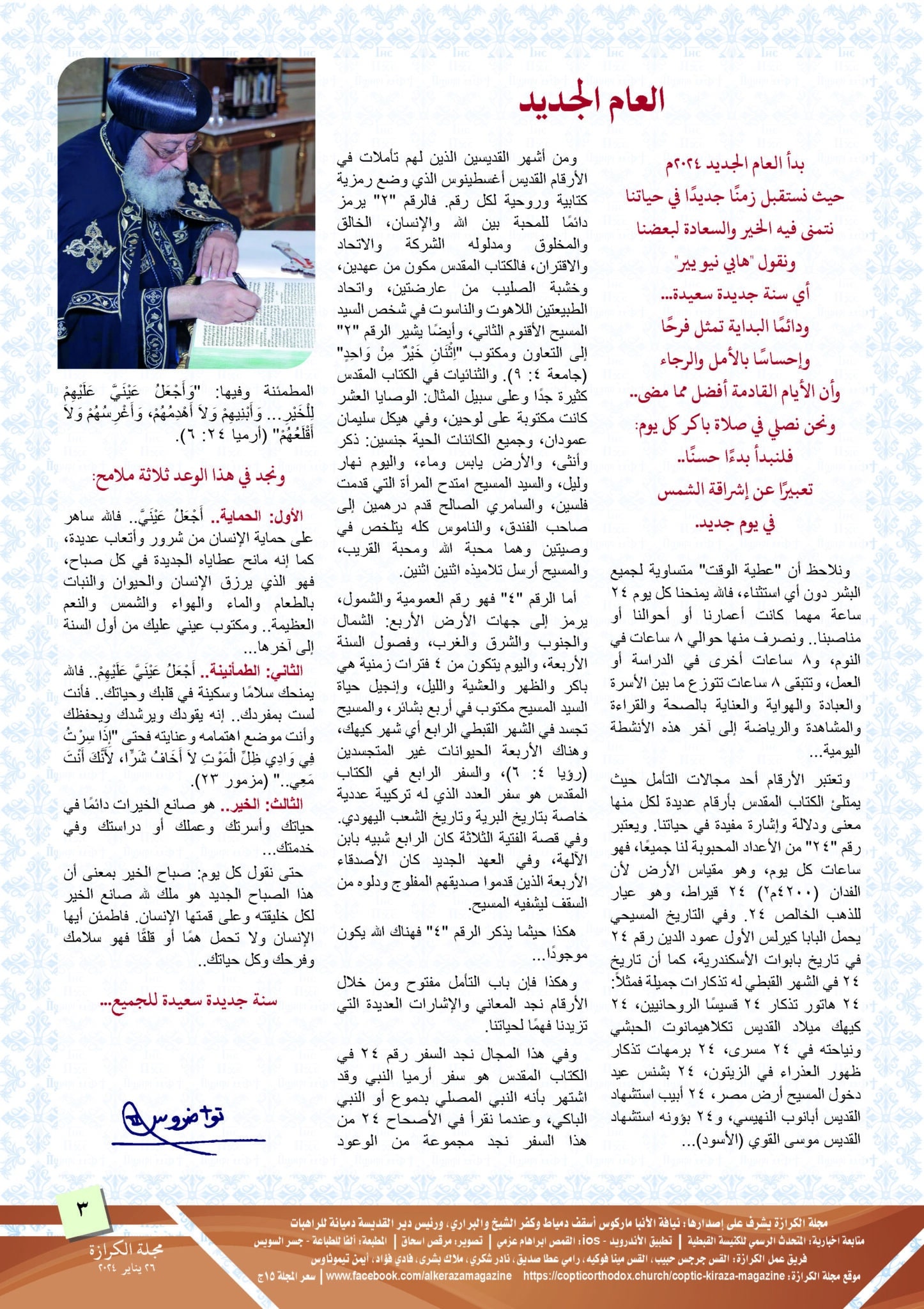
Editorial Article by H.H. Pope Tawadros II in Kiraza Magazine: New Year

January 26, 2024
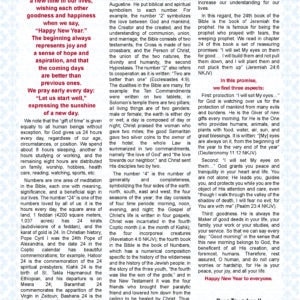
Keraza 26-1-24 Final-2_Page_2

The new year, 2024,

has begun as we begin

a new time in our lives,

wishing each other

goodness and happiness

when we say,

“Happy New Year.”

The beginning always

represents joy and

a sense of hope and

aspiration, and that

the coming days

are better than

previous ones.

We pray early every day:

“Let us start well,”

expressing the sunshine

of a new day.

We note that the “gift of time” is given equally to all human beings without exception, for God gives us 24 hours every day, regardless of our age, circumstances, or position. We spend about 8 hours sleeping, another 8 hours studying or working, and the remaining eight hours are distributed on family, worship, hobbies, health care, reading, watching, sports, etc.

Numbers are one area of meditation in the Bible, each one with meaning, significance, and a beneficial sign in our lives. The number “24” is one of the numbers loved by all of us: it is the hours every day, the square area of land, 1 feddan (4200 square meters, 1.037 acres) has 24 kirats (subdivisions of a feddan), and the karat of gold is 24. In Christian history, Pope Cyril I was the 24th Pope of Alexandria, and the date 24 in the Coptic calendar has beautiful commemorations; for example, Hatoor 24 is the commemoration of the 24 spiritual presbyters; Kiahk 24 is the birth of St. Takla Haymanout the Ethiopian, and his departure is on Mesra 24; Baramhat 24 commemorates the apparition of the Virgin in Zeitoun; Bashans 24 is the Feast of Christ’s Entry Into Egypt; Abib 24 is the martyrdom of St. Abanoub of Nihisa; and Baona 24 is the martyrdom of Saint Moses the Strong (Black).

One of the most famous saints who has meditations on numbers is Saint Augustine. He put biblical and spiritual symbolism to each number. For example, the number “2” symbolizes the love between God and mankind, the Creator and the created, and the understanding of communion, union, and marriage; the Bible consists of two testaments; the Cross is made of two crossbars; and the Person of Christ, the union of the two natures, the divinity and humanity, the second Hypostasis. The number “2” also refers to cooperation as it is written: “Two are better than one” (Ecclesiastes 4:9). The dualities in the Bible are many, for example: the Ten Commandments were written on two tablets; in Solomon’s temple there are two pillars; all living things are of two genders: male or female; the earth is either dry or wet; a day is composed of day or night; Christ praised the woman who gave two mites; the good Samaritan gave two silver coins to the owner of the hotel; the whole Law is summarized in two commandments, namely “the love of God” and “the love towards our neighbor;” and Christ sent His disciples two by two.

The number “4” is the number of generality and completeness, symbolizing the four sides of the earth: north, south, east and west; the four seasons of the year; the day consists of four time periods: morning, noon, evening, and night; the Gospel of Christ’s life is written in four gospels; Christ was incarnated in the fourth Coptic month (i.e. the month of Kiahk); the four incorporeal creatures (Revelation 4:6 NKJV); the fourth book in the Bible is the book of Numbers, which has a numerical composition specific to the history of the wilderness and the history of the Jewish people; in the story of the three youth, “the fourth was like the son of the gods;” and in the New Testament it was the four friends who brought their paralytic friend and lowered him down from the ceiling to be healed by Christ. Thus, wherever the number “4” is mentioned, God exists.

Similarly, there exists the opportunity for meditation, and through numbers we find many meanings and signs that increase our understanding for our lives.

In this regard, the 24th book of the Bible is the book of Jeremiah the prophet. He is famous for being the prophet who prayed with tears, the weeping prophet. We read in chapter 24 of this book a set of reassuring promises: “I will set My eyes on them for good … I will build them and not pull them down, and I will plant them and not pluck them up” (Jeremiah 24:6 NKJV).

In this promise,

we find three aspects:

First: protection. “I will set My eyes…” for God is watching over us for the protection of mankind from many evils and burdens. He is the Giver of new gifts every morning, for He is the One who provides humans, animals, and plants with food, water, air, sun, and great blessings. It is written: “[My] eyes are always on it, from the beginning of the year to the very end of the year” (Deuteronomy 11:12 NKJV).

Second: “I will set My eyes on them…” God grants you peace and tranquility in your heart and life. You are not alone; He leads you, guides you, and protects you while you are the object of His attention and care, even “though I walk through the valley of the shadow of death, I will fear no evil; for You are with me” (Psalm 23:4 NKJV).

Third: goodness. He is always the Maker of good deeds in your life, your family, your work or your studies, and your service. So that we can say every day: “Good morning” in the sense that this new morning belongs to God, the beneficent of all His creation, and foremost, humans. Therefore, rest assured, O human, and do not carry worries or hardship, for He is your peace, your joy, and all your life.

Happy New Year to everyone.
Keraza 26-1-24 Final-2_Page_1
Keraza 26-1-24 Final-2_Page_2

Latest News

H.H. Pope Tawadros II Receives Minister of Housing Eng. Randa El-Menshawy in New Alamein City and Commends the City's Development Achievements

H.H. Pope Tawadros II Receives Minister of Housing Eng. Randa...

H.H. Pope Tawadros II Prays the Divine Liturgy in El Alamein

H.H. Pope Tawadros II Prays the Divine Liturgy in El...

H.H. Pope Tawadros II Attends the Graduation Ceremony for Preparatory School Students at St. Mark's School in Alexandria

H.H. Pope Tawadros II Attends the Graduation Ceremony for Preparatory...

  • Home
  • Coptic Church
  • Holy Synod
  • Pope Tawadros II
  • Monasteries & Dioceses
  • Entities
  • News
  • Home
  • Coptic Church
  • Holy Synod
  • Pope Tawadros II
  • Monasteries & Dioceses
  • Entities
  • News
Facebook-f Instagram Youtube X-twitter Threads Soundcloud Bullseye